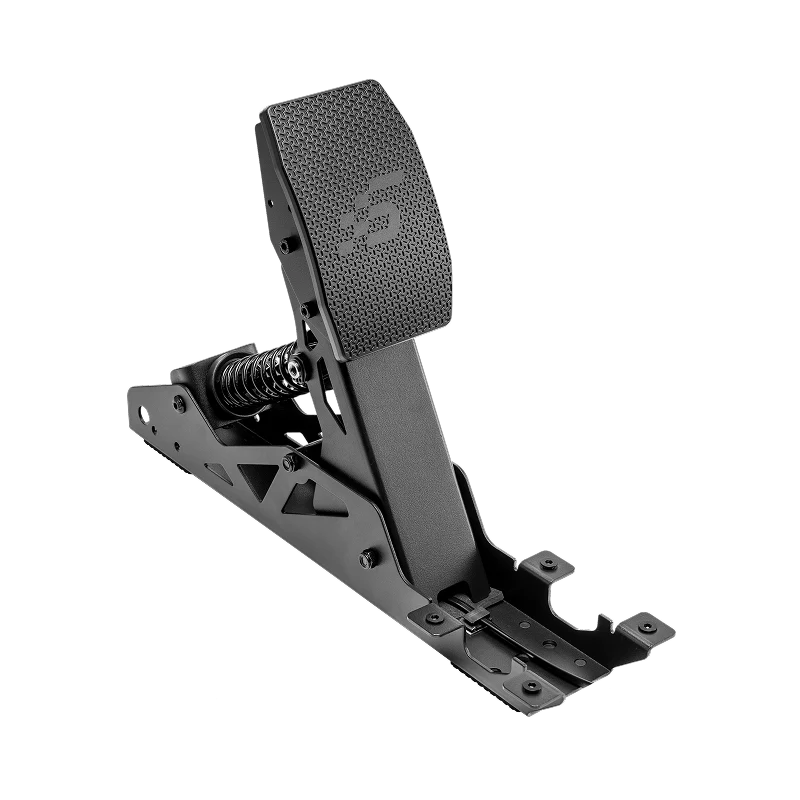
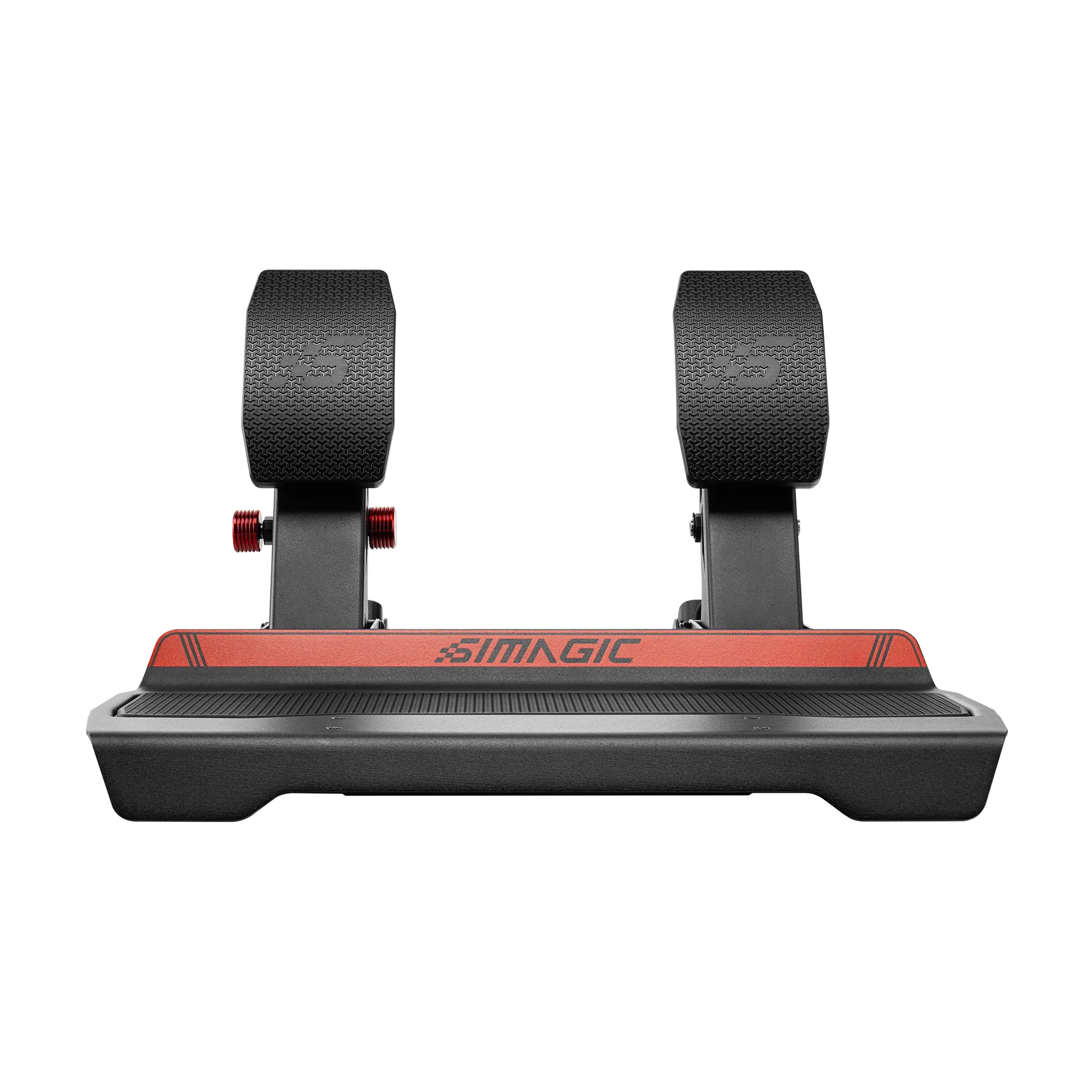
Simagic P700 dual sensor braking system - load cell and Hall angle sensor

Dual-sensor braking: loadcell + Hall

The brake combines a 150 kg loadcell with a 12-bit Hall angle sensor. In loadcell mode the pedal measures applied force - the way a real braking system works - which builds accurate muscle memory and repeatable braking points. In Hall mode it measures pedal travel instead, suited to floor use with softer elastomers and a progressive, road-car response.

Full-Range Adaptive Sensing adjusts signal gain across the whole braking range: during calibration the system learns the driver's real force window, then applies the optimal amplification at every force level - light corrections stay out of the noise, maximum braking stays controllable.

Simagic P700 - 35 adjustable brake settings from GT4 to TCR

From road car to TCR: 35 brake settings

35 brake setup combinations cover everything from long-travel passenger-car softness through sports-car firmness to track-focused GT4 and TCR stiffness. Coil springs in multiple stiffness levels deliver linear resistance, while 55° and 75° elastomers combined with compression springs replicate the progressive, non-linear feel of a real racing brake.

The quick-change system swaps setups without complicated disassembly - and the throttle and clutch support elastomer changes too.

Simagic P700 full adjustability - pedal angle, height and module spacing

Tailored fit with full adjustability

Pedal face angle tilts forward or back to match the seating posture, pedal height adjusts for different foot sizes, and module spacing sets the pedal width to suit the cockpit and driving style.

The extra-large footrest with a custom silicone heel plate adds anti-slip grip, stays comfortable barefoot and conceals the mounting screws - the high-strength steel structure underneath withstands up to 200 kg of pedal force.

Simagic P700 flexible mounting options - floor, wall mount and cockpit

Floor, wall or cockpit - mounting for every setup

Anti-slip rubber feet and included carpet grips keep the P700 stable on the floor at home - no rig required. The optional P700-WM wall mount secures the pedals against a wall, and for maximum consistency they bolt to aluminium profile cockpits, including inverted installation.

Start with a forgiving angled floor setup and transition to an upright, race-style cockpit position as car control improves - the pedals grow with the driver.

Manual, Downloads and Technical details

Manual
Simagic P700 user manual (PDF)
Simagic P700 quick guide (PDF)
Simagic P700 dimensions (PDF)


Download

SimPro Manager download


Technical Details

  • Pedal material: high-strength steel (withstands up to 200 kg of pedal force)
  • Heel plate material: silicone
  • Sensor system: dual sensors (Hall angle sensor + loadcell sensor)
  • Loadcell range: 150 kg
  • Angle sensor resolution: 12-bit (high-accuracy Hall-effect sensor)
  • Adjustable spring resistance: brake / throttle / clutch
  • Adjustable pedal face: height and angle
  • Adjustable module spacing: supported
  • Floor use: supported (carpet grips included), inverted mounting supported
  • Adjustable linearity and pedal force: supported (SimPro Manager)
  • Dimensions: 358 x 413 x 218 mm
  • Net weight: 3.6 kg
  • Certifications: FCC, RCM, VCCI, EAC, RoHS, CE, REACH
  • Warranty: 24 months
Compatibility

PC only!


Connection methods

  • USB directly to PC - works alongside wheelbases from all major sim racing brands
  • RJ45 to Simagic Alpha EVO series wheelbases
  • USB to Simagic Alpha series wheelbases


Mounting

  • Floor use with included anti-slip feet and carpet grips
  • Aluminium profile cockpits, including inverted installation
  • Optional P700-WM wall mount


Optional accessories

  • C-P700 clutch module - expands the set to a full three-pedal layout
  • P-HPR / P-HPR GT linear haptic pedal reactors - ABS, traction control and wheel slip vibration feedback
  • P700-WM wall mount
What is in the package?
  • P700 Pedals
  • Brake Performance Kit
  • Screw and Wrench Kit
  • Data Cable
  • USB Cable

What our customers say about this product

What is the difference between the loadcell and the Hall sensor mode?

Hall sensor mode measures pedal travel (angle) and is recommended for floor use with softer elastomers - suited to casual driving and road-car-style braking. Loadcell mode measures applied force and is recommended for rigid cockpit mounting with stiffer elastomers - real vehicles slow down by pressure applied through the braking system, which makes loadcell braking more realistic and helps build accurate muscle memory.

What is the difference between coil springs and elastomers?

Coil springs provide linear resistance that increases evenly as the pedal is pressed - available in multiple stiffness levels for throttle, clutch and road-car-style brake feel. Elastomers provide non-linear resistance: soft at the beginning, firmer through the mid-stroke and significantly stiffer at the end, which closely resembles a real brake pedal. The P700 uses 55° and 75° elastomers combined with compression springs for this progressive racing feel.

Do I need a cockpit or pedal mount to use the P700?

Not necessarily. The P700 includes anti-slip rubber feet and carpet grips for stable floor use. An optional P700-WM wall mount adds support when the pedals sit against a wall. For the best performance and consistency, the pedals can also be mounted to a cockpit and support inverted installation.

How do the P700 pedals connect to my setup?

Three connection methods are supported: RJ45 connection to Simagic Alpha EVO series wheelbases, USB connection to Simagic Alpha series wheelbases, or USB directly to the PC. Thanks to the direct USB option, the P700 works alongside wheelbases and cockpits from all major sim racing brands.

What do the optional P-HPR haptic reactors add?

P-HPR and P-HPR GT are Simagic's linear haptic feedback modules that bolt onto the pedals. Configured in SimPro Manager or SimHub, they simulate effects such as ABS vibration, and telemetry data like traction control or wheel slip can be mapped to vibration feedback for extra immersion.